from €0.00 EUR
Duration: 8 Minutes
Organized by: lastsupperticket.com
When you step into the Refectory of Santa Maria delle Grazie, you are not just looking at a wall; you are witnessing a psychological explosion frozen in time. However, Leonardo da Vinci’s masterpiece is full of secrets that remain invisible to the naked eye.
We have designed this free 8-minute audio guide to accompany you during your limited time slot in the museum.
Don’t just look at the painting—read it with us:
- Why is Judas clutching a bag of silver and spilling the salt?
- Where are Jesus’s feet, and how did a kitchen renovation in 1652 damage the artwork?
- Why does the menu on the table feature “grilled eel with orange slices” instead of just bread?
- How did this fragile wall miraculously survive the WWII bombings that destroyed the rest of the building?
Put on your headphones, press play below, and let us guide you through the “magic trick” Leonardo created 500 years ago.
You can access, download, and listen to our audio guide below:
Download Here (please right click and save)
Listen here:
Our Audio-Guide Text:
- Audio Guide: The Last Supper (Cenacolo Vinciano)
- Duration: Approx. 8 Minutes
- Last Update: 06.01.2026
(0:00 – 1:03) Introduction: Entering the Scene
Welcome. Please, take a deep breath. You have passed through the humidity-controlled airlocks, the heavy doors have closed behind you, and the noise of Milan has faded away. You are now standing in the Refectory—the ancient dining hall—of the Dominican convent of Santa Maria delle Grazie.
Before we rush to the masterpiece on the wall, I want you to just stand comfortably and feel the space around you. For centuries, monks sat along these long walls, eating their simple meals in total silence.
Now, look straight ahead at the north wall.
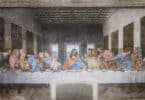
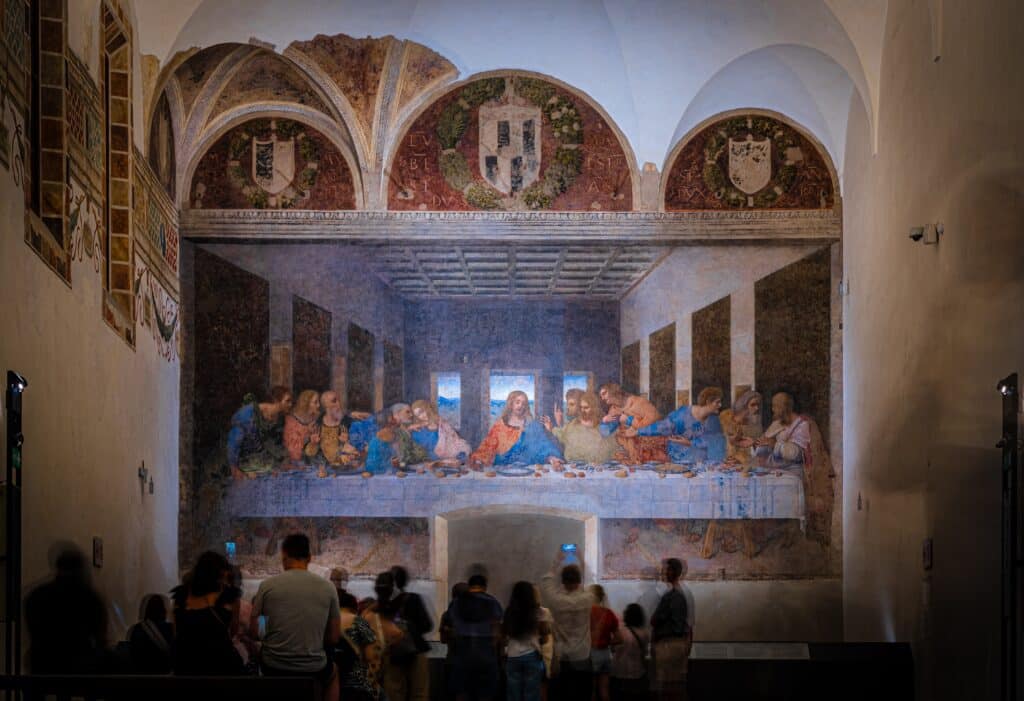
What you are seeing is not just a painting; it is a magic trick. Leonardo da Vinci designed this image to look like a natural extension of the very room you are standing in. Look at the painted tapestries on the side walls of the scene. Look at the painted ceiling beams above the table. Leonardo copied the architecture of this actual dining hall so that the monks would feel like Jesus and the disciples were dining right there with them, sharing the same space.
(1:03 – 2:10) The Vanishing Point and The Moment
Now, look at the very center of the painting, right at the face of Jesus. Leonardo used a technique called linear perspective to force your eyes to this spot. In fact, if you could climb up a ladder, you would find a tiny hole in the plaster right at Jesus’s temple. Leonardo actually hammered a nail into the wall there and tied strings to it to map out the entire room. Every line in the floor, the ceiling, and the table radiates from, and returns to, the mind of Christ.
But this is not a peaceful dinner. Most artists before Leonardo painted the “Last Supper” as a quiet religious ceremony. But Leonardo? He chose to paint a psychological explosion.
He has captured the exact split-second after Jesus has spoken the terrifying words: “Truly I tell you, one of you will betray me.”
What you see is the shockwave of those words. In the center, Jesus is calm. But around him, the twelve disciples are erupting into chaos. They are arranged in four groups of three. Let’s read this painting together, from left to right, just like a book.
(2:10 – 3:53) The Left Side: The Betrayal
I want you to look at the first group on the far left. You see three men: Bartholomew, James the Minor, and Andrew. Look at the figure on the far left, Bartholomew. He has leaped to his feet so fast that his legs are crossed; his hands are pressing on the table as if to say, “Surely not?” Next to him, the older man with the long grey beard is Andrew; he holds his hands up, palms out, in a gesture of absolute stunned silence.
Now, slide your eyes to the next group of three. This is the most dramatic part of the painting. Here we have Judas, Peter, and John.
Focus on the figure in the shadow, the one leaning back, away from Jesus. That is Judas. Leonardo gives us secret clues about him. First, look at his right hand on the table—he is clutching a small bag. That is the bag of silver, the price of his betrayal. Second, look just by his elbow. Do you see the overturned salt cellar? He has spilled the salt. In the Renaissance, spilling salt was a universal sign of bad luck and evil. And finally, notice that while everyone else is pulling away or asking questions, Judas is the only one reaching for the same bowl as Jesus.
Behind Judas is Peter, the one with the grey beard. He looks angry. He is leaning in, whispering to John. But look closely at Peter’s hand resting on his hip, twisted behind his back. Do you see it? He is holding a knife. This is a brilliant detail—it foreshadows that later that night, Peter will draw his sword to defend Jesus.
(3:53 – 4:59) The Center: Jesus and the Missing Feet
Now, bring your eyes back to the center. Jesus.
Amidst all this chaos, he is the calm eye of the storm. He forms a perfect triangular shape—a symbol of the divine. His head is lowered, his eyes downcast. He is isolated; no one touches him. His left hand is open, palm up, offering forgiveness.
Now, I want you to look at something tragic. Look directly under the table, beneath Jesus. You will see a large, dark rectangular archway that cuts into the painting. You might be wondering: “Where are Jesus’s feet?”
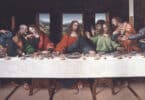
Well, in the year 1652, the monks decided their food was getting cold on the way from the kitchen, so they cut a new door through the wall to connect the kitchen to this room. In doing so, they chopped off the bottom of Leonardo’s masterpiece. We know from early copies that Jesus’s feet were originally visible, crossed one over the other, symbolizing the crucifixion to come. But history, unfortunately, often chooses practicality over art.
(4:59 – 6:04) The Right Side: Doubt and Debate
Now, let your eyes jump across Jesus to the group on his right—your left.
Here we see Thomas, James Major, and Philip. Look at Thomas—he is the one with his index finger pointing straight up to the sky. He looks like he is asking a question. This is the same finger that will later doubt the resurrection, needing to touch Jesus’s wounds. Next to him, James Major throws his arms out wide, staring at the bread and wine, stunned. And Philip, the gentle figure in red, points to his own chest, looking at Jesus with a face that asks, “Lord, is it me? Am I the one?”
Finally, look at the last group on the far right end of the table: Matthew, Thaddeus, and Simon. Notice their body language. They aren’t looking at Jesus anymore. They are looking at each other. Matthew—the blonde figure—gestures with his arms toward Jesus, as if explaining the situation to the older Simon on the far end. They are debating the news, the shock still rippling outward to the edges of the table.
(6:04 – 7:08) The “Menu” and The Technique
Now, let’s look at a detail only experts usually notice. Look at the table itself. The tablecloth has sharp creases, showing it has just been unfolded. And the food? It’s hard to see because of the damage, but recent analyses revealed a surprise. It isn’t just bread and lamb. Leonardo likely painted grilled eel with orange slices. Why? Because that was a popular, luxurious dish in Renaissance Milan. He wasn’t painting a historical dinner; he was painting a menu that the monks and his wealthy patrons would recognize from their own lives.
You might also ask: “Why does the painting look so faded?” This is because of Leonardo’s perfectionism. A normal wall painting, a “fresco,” must be done fast on wet plaster. Leonardo hated working fast. So, he invented a new technique using oil on dry wall. It was a failure. The paint began to flake off only 20 years after it was finished. What you see today is a ghost, held together by restoration.
(7:08 – 8:02) Conclusion: The Survivor
Finally, lift your eyes way up, above the painting. You see three curves, or “lunettes,” containing wreaths of fruit and coats of arms. These belong to the Sforza family, the Dukes of Milan who paid for this work.
As you take your last look, remember this: In August 1943, during World War II, a bomb struck this very building. The roof collapsed. The other walls were destroyed. But this wall—protected only by sandbags and a wooden scaffold—remained standing amidst the rubble.
It is a miracle that we can stand here today. Leonardo da Vinci froze a moment of human emotion on this wall 500 years ago, and despite everything, the conversation at this table is still going on.
Thank you for listening. Please, enjoy the silence and the presence of this timeless masterpiece.
[End Audio]
from €129.00 EUR
Duration: 12 Hours
Organized by: Z V SRL
410 Reviews
from €149.00 EUR
Duration: 12.5 Hours
Organized by: Zani Viaggi Srl
1.807 Reviews
from €139.00 EUR
Duration: 1 Day
Organized by: Z V SRL
25 Reviews
from €139.00 EUR
Duration: 13 hours
Organized by: Z V SRL
767 Reviews
from €129.00 EUR
Duration: 14 hours
Organized by: Z V SRL
758 Reviews
from €79.00 EUR
Duration: 9 hours
Organized by: Z V SRL
3 Reviews
from €22.00 EUR
Duration: 1 Day-48 Hours
Organized by: Sightseeing Experience
6.182 Reviews
from €140.00 EUR
Duration: 2 hours
Organized by: Keys Of Italy / Milan and Venice
19 Reviews
from €236.00 EUR
Duration: 1 Day
Organized by: Your Travel Diary
from €138.00 EUR
Duration: 6 Hours
Organized by: Wander Italy
304 Reviews